
A young, healthy-looking Newfoundland collapses briefly during play, then gets back up like nothing happened. Most owners write it off. One specific, heritable heart defect makes that dismissal genuinely dangerous in this breed, more than in almost any other.
Newfoundland Pet Insurance: The 35x Heart Risk Nobody Names
A brief collapse during a normal play session. A dog that seems fine seconds later, tail wagging, ready to keep going. For most breeds, this gets chalked up to overexertion.
For a Newfoundland, it’s one of the more recognizable warning signs of a specific, well-documented congenital heart defect that current pet insurance guides for this breed simply don’t name.
Newfoundland pet insurance guides consistently mention “heart problems” or, at best, dilated cardiomyopathy. What gets left out, across nearly every source we reviewed, is the single condition with the most dramatic, best-documented breed-specific risk data of anything on this list: subvalvular aortic stenosis, or SAS.
Why subvalvular aortic stenosis Newfoundland cases get missed
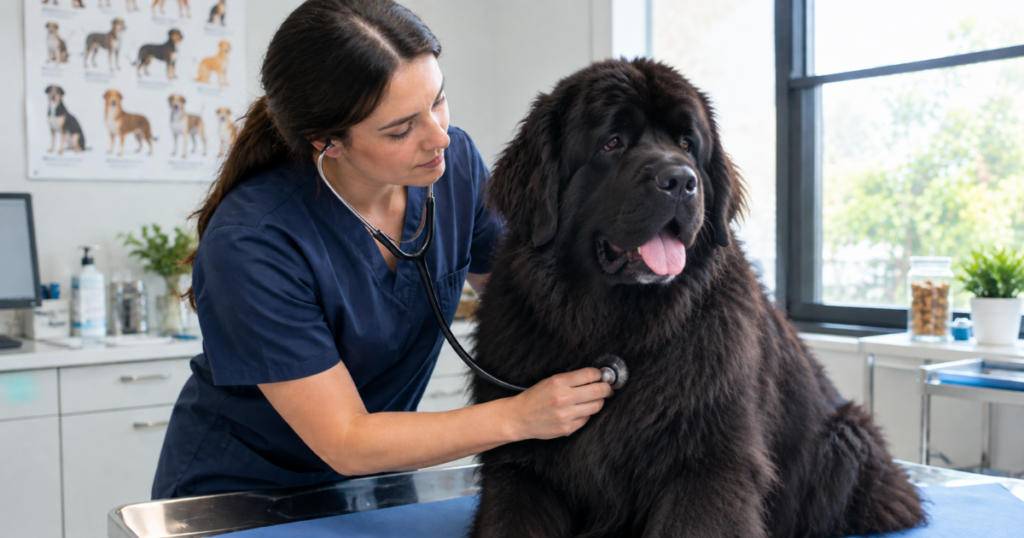
Part of what makes this condition genuinely dangerous is how quiet it can be. A mild-to-moderate murmur can be subtle enough that it’s missed during a routine exam, especially in a young, active, otherwise healthy-looking puppy where nobody is specifically listening for a cardiac issue.
Subvalvular aortic stenosis Newfoundland screening ideally happens through a careful cardiac auscultation at every puppy visit, not just once. A murmur that wasn’t there at 8 weeks can appear by 6 months as the obstruction develops, which is part of why a single clean puppy exam doesn’t rule this out for good.
What SAS actually is, and why the number is this extreme
Subvalvular aortic stenosis is a ridge or ring of fibrous tissue that forms just below the aortic valve, inside the heart, partially obstructing blood flow out of the left ventricle. The heart has to work harder to push blood past the obstruction, which over time can lead to an enlarged, thickened heart muscle as it compensates for the added strain.
Newfoundlands aren’t just “at risk” the way many breeds are loosely described as at risk for various conditions. A study out of a major veterinary teaching hospital found Newfoundlands carried 34.73 times higher odds of an SAS diagnosis than other breeds, alongside a 4.46% prevalence rate, both the highest recorded figures for any single breed studied in that dataset.
Mild versus severe SAS: a genuinely different outlook
The genetic discovery behind this breed’s risk
This isn’t just a statistical pattern without an explanation. In 2014, researchers identified a specific genetic variant, a single-codon insertion in a gene called PICALM, associated with SAS specifically in Newfoundlands. It remains one of the only confirmed genetic variants linked to this condition in any dog breed.
This matters for Newfoundland dog health problems generally: unlike many breed-linked conditions where the underlying genetics are still unclear, SAS in this breed has an identified molecular cause, which is part of why responsible breed clubs have taken screening so seriously.
A breed club actually did something about it
A 14-year cardiovascular screening program run by the French Newfoundland breed club tested 921 dogs for SAS between 2010 and 2023. By the final three years of the program, no new SAS diagnoses were being found at all, a genuinely encouraging sign that structured screening and careful breeding can meaningfully reduce a hereditary risk over time.
Similar breed-club screening initiatives aren’t yet standard everywhere, so asking a breeder directly about cardiac testing in a puppy’s parents remains one of the more useful questions a prospective Newfoundland owner can ask.
What SAS diagnosis and treatment actually cost
| Step | What it involves |
|---|---|
| Cardiac auscultation and initial workup | Vet visit where a heart murmur is often first detected |
| Echocardiogram (definitive diagnosis) | Doppler ultrasound to measure the pressure gradient and confirm severity |
| Ongoing management (moderate to severe cases) | Beta-blocker medication and periodic cardiology monitoring |
Echocardiogram screening for large-breed heart conditions like this one commonly runs $300 to $800 depending on the clinic and whether a veterinary cardiologist performs it, versus a general practice vet. Ongoing medication and monitoring for a diagnosed case adds a recurring cost on top of that initial workup.
The insurance question this breed’s risk actually raises
The genuine gray area
Once SAS is diagnosed after enrollment and your policy’s waiting period has passed, treatment and ongoing management are generally covered the same as any other illness under a standard accident-and-illness plan.
The harder question is the screening itself: an echocardiogram performed proactively, before any symptom or murmur is documented, is typically treated as preventive and isn’t covered by most standard policies.
Given how concentrated this breed’s SAS risk is, and how much a murmur discovered during a routine puppy exam can matter, the practical takeaway is straightforward: enroll in newfoundland pet insurance before any veterinary visit that could document a heart murmur, not after.
What newfoundland insurance cost actually looks like
Newfoundland pet insurance cost estimates from several independent sources land in a fairly consistent range, generally $50 to $105 a month for a standard accident-and-illness policy on an adult dog, with location, age, deductible, and annual limit all moving the exact figure.
Given this breed’s genuine combination of cardiac and orthopedic risk, and the size of this dog driving up per-procedure treatment costs generally, budgeting toward the higher end of that range for meaningful annual coverage is a reasonable approach.
A policy with a higher annual limit matters more here than for a small breed with a lower average lifetime claim cost, given how quickly large-breed surgical and cardiac care can add up.
Beyond SAS: the rest of the risk picture
SAS is the most statistically dramatic Newfoundland dog health problem, and the most significant form of newfoundland heart disease specifically, but not the only condition worth insuring against. Hip dysplasia is well documented in the breed given its size and growth rate.
Bloat carries the same deep-chested-breed risk profile seen across other giant and large breeds, a genuine emergency where hours, not days, determine the outcome.
Some Newfoundland owners choose preventive gastropexy, a procedure that tacks the stomach in place to reduce future bloat risk, often performed alongside spay or neuter surgery. Standard policies typically treat this as elective rather than covering it outright, which is worth confirming directly with any insurer you’re considering.
Newfoundlands also face elevated risk of cystinuria, a hereditary condition affecting how the kidneys process certain amino acids, which can lead to bladder stone formation requiring surgical treatment if untreated. A urine screening test can identify affected dogs before stones ever form, giving owners a genuine window to manage the condition through diet before it becomes a surgical emergency.
Recognizing the warning signs early
Beyond a brief collapse during exercise, other signs worth mentioning to your vet directly include unusual tiring during normal play, a bluish tinge to the gums during exertion, or coughing that doesn’t seem tied to anything obvious.
None of these signs alone guarantee SAS specifically, several other conditions can cause similar signs, but they’re all reasons to ask for a thorough cardiac evaluation rather than assuming a young, large-breed dog is simply clumsy or out of shape.
What to actually do as a Newfoundland owner
- Enroll in insurance as early as possible, ideally as a puppy, before any veterinary visit has a chance to document a heart murmur or other SAS-related finding.
- Ask your vet to listen carefully for a heart murmur at every routine visit, particularly during the first year, since this is often the earliest detectable sign, and a murmur present at 6 months isn’t always audible at 8 weeks.
- Discuss echocardiogram screening with your vet directly, understanding that if pursued before enrollment or during a waiting period, any finding could affect future coverage for the condition.
- Ask breeders about SAS screening in the parent dogs if you’re getting a puppy, given the identified genetic component and existing breed-club screening efforts in some regions. A breeder who can’t answer this question at all is worth being cautious about.
Frequently asked questions
Yes, under a standard accident-and-illness policy, as long as the condition wasn’t diagnosed or symptomatic before enrollment and the waiting period has passed. Ongoing management, including medication and monitoring, is generally covered the same as any other diagnosed illness.
A large veterinary teaching hospital study found a 4.46% prevalence rate and 34.73 times higher odds of diagnosis compared to other breeds, both the highest figures recorded for any breed in that dataset.
A specific genetic variant in the PICALM gene has been identified as associated with SAS in Newfoundlands, one of the only confirmed genetic links to this condition in any breed, though widespread commercial genetic testing based on this discovery is not yet as established as tests for some other hereditary conditions.
Generally $50 to $105 a month for a standard accident-and-illness policy on an adult dog, based on several independent sources, with age, location, deductible, and annual limit all affecting the exact figure.
Severity is measured by the pressure gradient across the obstruction. Mild cases often allow a normal lifespan with minimal symptoms, while severe cases carry a median survival of just 3.0 years and real risk of fainting, heart failure, or sudden death.
As early as possible, ideally as a puppy, before any veterinary visit could document a heart murmur or other SAS-related finding. Given how concentrated this breed’s cardiac risk is, enrollment timing matters more here than for many breeds.
The bottom line on newfoundland pet insurance
Most breed guides for Newfoundlands stop at a vague “heart problems” mention. The real picture is more specific and more useful: a documented, genetically-linked condition with a dramatically elevated odds ratio, an identified gene variant, and a real range of outcomes from unremarkable to genuinely serious.
Enrolling before any murmur is documented is the single decision that determines whether this risk is actually covered if it appears.
For related large-breed cardiac risk, see our guide on Great Dane pet insurance, which covers a different heart condition in a similarly giant breed. For the broader hip dysplasia risk mentioned above, see our Hip Dysplasia coverage guide, and for how enrollment timing interacts with pre-existing rules generally, see our Pre-Existing Conditions guide.
Sources
- Subvalvular Aortic Stenosis: Learning From Human and Canine Clinical Research (peer-reviewed)
- A Single Codon Insertion in PICALM Is Associated With Development of Familial Subvalvular Aortic Stenosis in Newfoundland Dogs (peer-reviewed)
- Congenital Pulmonic and Aortic Stenosis in Newfoundland Dogs: Results of a 14-Year French Cardiovascular Screening Program (peer-reviewed)
- MSPCA-Angell, Subaortic Stenosis
Sarah researches and writes PetCoverToday's guides, checking every cost figure, coverage term, and policy rule directly against insurers' own published pages and, where relevant, veterinary and industry sources. PetCoverToday is an independent research resource, not a licensed insurance agency, and does not sell policies directly. Read more about how we research and fact-check every guide.