
A Great Dane can look completely healthy right up until the exact week everything changes. For this specific breed, that week can be devastatingly short.
Great Dane Pet Insurance: The 5-Week Warning
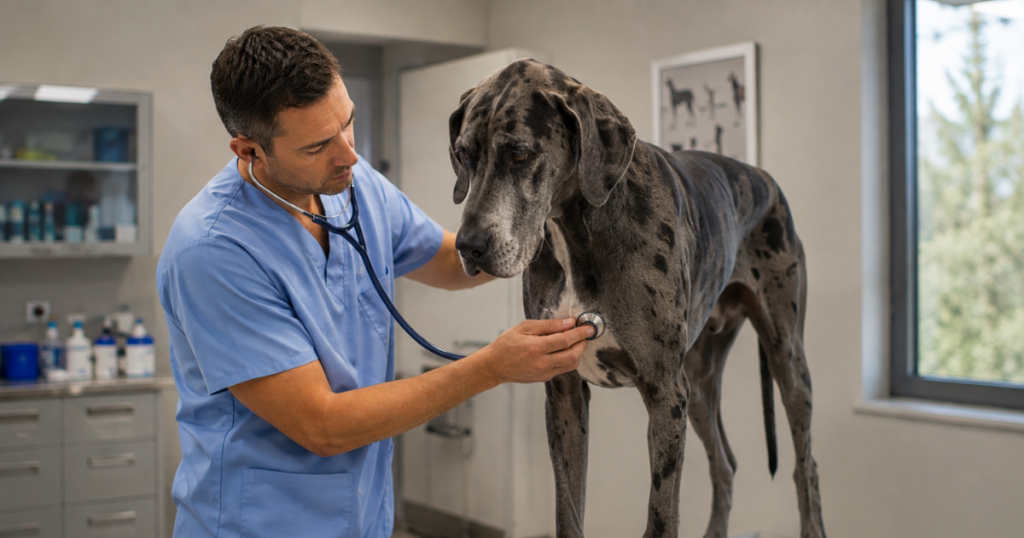
A vet examines a Great Dane that’s eaten a popular grain-free diet for years. The owner wants a cardiac ultrasound, just to be safe, and her vet genuinely agrees it’s warranted given everything known about the breed’s risk profile and the dog’s specific dietary history over that time.
The dog genuinely seems fine right now. No coughing, no fainting, no obvious signs at all.
The insurance company says no. Asymptomatic dogs don’t qualify for the screening under this specific policy’s stated terms. This is a real, documented case, and it captures exactly why Great Dane pet insurance needs to account for a condition most owners have never heard explained clearly.
Great Dane pet insurance conversations usually center on bloat, and rightly so, given how well documented that specific risk already is. What gets far less attention is a heart condition that kills faster in this breed than almost any other documented risk we’ve researched, and a genuinely confusing insurance question about whether it’s even preventable to catch early.
What dilated cardiomyopathy actually is
Dilated cardiomyopathy, DCM, is a genuinely serious disease of the heart muscle itself. The heart enlarges and its walls thin, so it pumps blood less effectively.
In Great Danes specifically, research from NC State University’s College of Veterinary Medicine has confirmed a genetic basis, and a Swedish survey of insured pedigree dogs found the breed has the third highest heart disease death rate of any breed studied.
What makes this particularly severe in Great Danes isn’t just that it happens, it’s how fast it progresses once symptoms appear.
UFAW’s veterinary summary cites research finding an average survival of just 5 weeks after heart failure symptoms begin in this breed, compared to a 19-week average across all breeds with DCM at a cardiorespiratory referral center, a genuinely stark difference in outcome timing.
Not every DCM case is the same disease
The great dane pet insurance catch-22 almost nobody explains
This is where it gets genuinely complicated. A documented clinical case published by DVM360 describes a Great Dane fed a grain-free diet for six years, with no outward symptoms. The owner, concerned after the FDA’s diet warning became public, asked her vet for a cardiac ultrasound. The vet agreed it was warranted given the dog’s risk profile.
The insurance company refused to cover the screening because the dog was asymptomatic.
Early DCM often can’t be detected through a physical exam or even a stethoscope, an ultrasound is frequently the only way to catch it before symptoms appear, but many policies simply won’t pay for diagnostic screening on a dog that isn’t already showing signs of illness in some clearly documented way.
Why this timing trap matters so much
By the time symptoms are obvious enough for insurance to approve testing, the disease has often already progressed significantly, and in Great Danes specifically, the window between first symptoms and severe heart failure can be measured in weeks, not months at all. The condition that’s hardest to get covered proactively is exactly the one where early detection matters most.
The other risk Great Dane pet insurance conversations do cover well
Bloat, or gastric dilatation-volvulus, remains a genuinely severe, well-documented risk in this breed, with lifetime risk estimates as high as 42% in some sources. Unlike DCM’s quiet onset, bloat is a sudden, unmistakable emergency, and it’s the risk most existing content already explains reasonably well. See our full Bloat Coverage guide for the complete breakdown.
Orthopedic risk shouldn’t be overlooked either
Giant breeds carry substantial weight on a skeleton that’s still developing well into their second year, and Great Danes are no exception to this general pattern. Hip dysplasia and other orthopedic conditions are well-documented in large and giant breeds generally, and rapid growth during puppyhood is a recognized contributing factor.
Unlike DCM, orthopedic conditions in this breed tend to develop gradually rather than presenting as a sudden emergency, which makes early, subtle signs, occasional stiffness after rest, reluctance to jump, easy to miss or dismiss as normal puppy clumsiness.
What great dane insurance cost actually looks like
Great dane health insurance runs higher than average for a large breed, reflecting both the size-driven cost of care and the documented severity of conditions like DCM and bloat. Estimates generally cluster between $45 and $90 a month for an adult dog, with age and location shifting where you land in that range.
Pet insurance for great danes purchased as a puppy, before any cardiac or orthopedic symptoms have a chance to appear, remains the single biggest lever for actually getting this breed’s most severe risks covered rather than excluded.
What DCM diagnosis and treatment actually costs
| Item | Typical cost |
|---|---|
| Cardiac ultrasound (echocardiogram) | $300 to $600 |
| Cardiology specialist consult | $150 to $400 |
| Cardiac biomarker bloodwork (Troponin, ProBNP) | $100 to $250 |
| Ongoing heart medication, monthly | $50 to $150 |
| Emergency hospitalization for heart failure | $1,500 to $4,000+ |
Diet-Associated DCM adds no direct testing cost beyond the standard workup, but genuinely useful diagnostic confirmation, ruling in or out a dietary cause, may require repeat echocardiograms 4 to 6 months after a diet change to assess whether heart function has actually improved over that period.
Why size itself compounds every risk on this list
A Great Dane puppy can gain more weight in its first year than most dog breeds weigh as adults, a growth rate that puts real strain on a developing skeleton and cardiovascular system simultaneously.
This isn’t a separate risk factor so much as a multiplier on everything already covered here, faster growth means orthopedic stress arrives earlier, and a proportionally larger heart has to work harder from the start.
It’s part of why giant breed owners are consistently advised to enroll insurance during the puppy stage specifically, rather than waiting until a dog reaches full adult size and any early-developing condition has already had time to show itself.
How to actually watch for early warning signs
Because early DCM often produces no detectable signs on a routine exam, owners are genuinely the first line of detection here, not the vet visit itself.
Subtle changes worth tracking include reduced stamina on walks your dog previously handled easily, occasional coughing that isn’t tied to excitement or exercise, and any episode of fainting or apparent weakness, even brief ones that resolve on their own.
None of these signs are exclusive to DCM, and none of them confirm anything without proper testing.
But documenting a pattern, rather than dismissing a single odd afternoon, gives your vet a genuinely useful starting point if cardiac disease does turn out to be the cause, and it can shift a borderline insurance conversation from “asymptomatic” to “worth investigating” faster than waiting for something dramatic to happen.
What to actually ask an insurer before enrolling
- Ask directly whether cardiac screening is covered for at-risk, asymptomatic dogs. As the documented case above shows, this varies, and it’s not something most policy summaries spell out clearly.
- Ask how the insurer classifies Diet-Associated DCM specifically. Since it isn’t purely genetic, some policies may treat it differently than breed-standard hereditary DCM, though this is genuinely inconsistent across providers.
- Enroll before any diet change conversation happens with your vet. If a vet visit already discusses diet-related heart risk before your policy starts, that conversation itself could be treated as an early symptom.
- Confirm whether hereditary conditions are covered by default, since genetic DCM falls squarely into that category for this breed.
Frequently asked questions
Yes, under a standard accident-and-illness policy, as long as no symptoms were documented before enrollment and the waiting period has passed. As a hereditary condition, confirm your policy doesn’t carry a blanket exclusion for genetic or breed-predisposed conditions.
Often not. A documented clinical case showed an insurer declining to cover a cardiac ultrasound for an asymptomatic, high-risk dog. This is a genuine coverage gap worth asking about directly before you need it, since it isn’t consistent across every provider.
Some providers may offer this as part of a wellness add-on rather than standard illness coverage, which is another reason to ask the specific question rather than assume the answer either way.
Not necessarily medically, since Diet-Associated DCM can be reversible while genetic DCM generally isn’t, but insurers may not distinguish between the two once either is documented.
Ask your specific provider how they classify a diet-linked diagnosis before assuming either outcome, since policy language on this remains genuinely inconsistent industry-wide.
Faster than in most breeds. Research cited by UFAW found an average survival of just 5 weeks after heart failure symptoms begin in Great Danes, compared to a 19-week average across all breeds with the condition.
Bloat (gastric dilatation-volvulus) remains the breed’s most well-documented emergency risk, with lifetime estimates as high as 42% in some sources. Hip dysplasia and other orthopedic conditions common to giant breeds are also worth confirming coverage for.
This is a veterinary question, not an insurance one, and should be discussed directly with your vet given your dog’s specific diet and risk factors. What matters for insurance is that enrolling before any related symptom or diagnostic conversation happens protects your ability to get coverage either way.
The bottom line on great dane pet insurance
Great Danes carry a heart disease risk that’s genuinely more severe, and progresses faster, than what most breed guides communicate. Between genetic DCM and the newer, more reversible Diet-Associated form, the science is more nuanced than a simple yes-or-no answer, and the insurance mechanics around preventive screening are murkier still.
Enrolling early, before any symptom or diet-related vet conversation is documented, remains the one lever that actually protects great dane pet insurance coverage for this specific risk.
For related breed risk profiles, see our guides on Boxer pet insurance and Bernese Mountain Dog pet insurance, two other breeds with documented cardiac risk. You can also learn more about how we research every guide on our About page.
Sources
- NC State University College of Veterinary Medicine, Great Dane Dilated Cardiomyopathy Genetics
- UFAW, Great Dane, Dilated Cardiomyopathy
- DVM360, Insurance Won’t Cover a DCM Diagnosis? (clinical case report)
- FDA, Investigation into Potential Link Between Certain Diets and Canine DCM
- Merck Veterinary Manual, Dilated Cardiomyopathy in Dogs and Cats
Sarah researches and writes PetCoverToday's guides, checking every cost figure, coverage term, and policy rule directly against insurers' own published pages and, where relevant, veterinary and industry sources. PetCoverToday is an independent research resource, not a licensed insurance agency, and does not sell policies directly. Read more about how we research and fact-check every guide.