
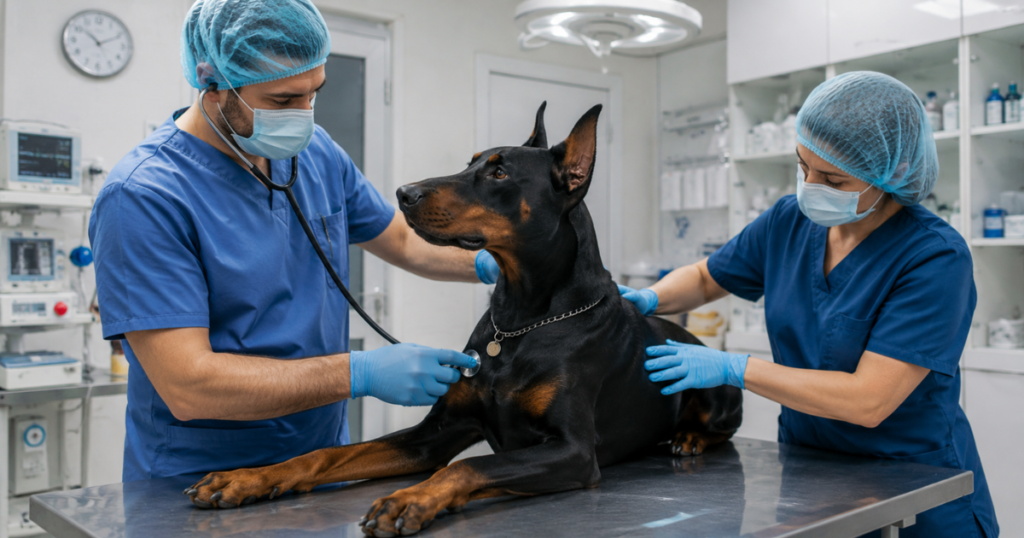
A routine neuter can uncover a hidden bleeding disorder in a Doberman. The medical emergency is real, but insurance coverage is not automatic. Here is what the veterinary research shows, what policies can exclude, and what to ask before surgery day.
A healthy-looking Doberman arrives at the veterinary hospital for a planned neuter. The preoperative examination has raised no obvious concerns. During surgery, however, bleeding is more difficult to control than expected. The veterinary team begins investigating whether an underlying clotting disorder could be involved.
This is an illustrative situation, not a documented insurance claim. It captures a problem Doberman owners should understand: von Willebrand disease can remain unnoticed until surgery or an injury. It also raises a separate financial question. If the neuter itself is excluded from insurance, will the treatment of a serious bleeding complication be covered?
Doberman pet insurance decisions usually begin with dilated cardiomyopathy, the inherited heart disease for which the breed is well known. That concern is justified. But Dobermans also have a substantial inherited risk of von Willebrand disease (vWD), a disorder that interferes with the body’s ability to stop bleeding.
The two conditions present very different insurance problems. Cardiomyopathy may require repeated heart monitoring, medication and emergency treatment. Von Willebrand disease may remain clinically quiet until a dental extraction, injury or elective operation makes bleeding control especially important.
For an owner, the useful question is not simply whether an insurer advertises hereditary-condition coverage. It is whether the policy covers a particular diagnosis, how it handles prior medical findings, and whether complications arising from an excluded procedure are themselves excluded.
Why von Willebrand Disease Matters in Dobermans
Von Willebrand disease is the most common inherited bleeding disorder in dogs. It involves von Willebrand factor (vWF), a protein that helps platelets adhere to damaged blood vessels and supports normal clot formation.
When the protein is deficient or does not function correctly, bleeding may last longer than expected. Affected dogs can have normal platelet counts and still experience problems because the platelets are not adhering effectively where they are needed.
The condition can cause bleeding from the nose or gums, bruising, prolonged bleeding after an injury and excessive bleeding during surgery. Some dogs show no obvious signs for years. Others experience clinically important bleeding much earlier.
VCA Animal Hospitals reports that more than 70% of 15,000 Dobermans screened in a research study were carriers, with most showing no clinical signs at the time of testing. This figure demonstrates the breed’s substantial inherited burden, but it does not mean seven out of ten Dobermans will experience dangerous surgical bleeding.
Carrier status, a genetic test result, circulating vWF concentration and actual bleeding tendency are related but not interchangeable. That distinction matters when an owner is deciding whether to test a healthy dog and when an insurer is evaluating the medical record.
The Three Types of von Willebrand Disease
Veterinarians classify vWD into three main types. The classification reflects the amount and function of von Willebrand factor, not simply whether a dog has ever experienced bleeding.
Compare the Forms Most Associated With These Breeds
Type II is another form in which von Willebrand factor has an abnormal structure and reduced function. Cornell associates Type II with breeds such as German Wirehaired and German Shorthaired Pointers.
Type I is generally the least severe classification, but describing it as harmless would be a mistake. A Doberman with Type I vWD may need special planning before surgery, particularly if the dog has a history of bleeding or low vWF activity.
For a concise veterinary explanation of the three types, see Cornell University’s von Willebrand disease guide.
Signs Owners May Notice Before Surgery
Not every Doberman with vWD will show symptoms, and the absence of symptoms does not rule out the disorder. Still, some signs deserve particular attention before an operation is scheduled.
- Unexplained nosebleeds: bleeding that occurs without a clear injury or recurs unexpectedly.
- Bleeding gums: more bleeding than expected during teething, chewing or dental examination.
- Easy bruising: visible bruises or prolonged bleeding after minor trauma.
- Blood in urine or stool: a possible sign of bleeding that requires veterinary investigation.
- Excessive bleeding after procedures: prolonged bleeding after a previous surgery, dental extraction or injury.
- Reproductive bleeding: unusual bleeding during a heat cycle or around whelping in an affected female.
These signs are not specific to vWD. Platelet disorders, toxins, liver disease and other conditions can also interfere with normal clotting. A veterinarian needs to determine the cause rather than assuming every Doberman nosebleed is inherited.
When Bleeding Is an Emergency
Seek urgent veterinary care for uncontrolled bleeding, collapse, pale gums, marked weakness, breathing difficulty or substantial blood loss. Do not wait for a genetic test, insurance approval or an estimate before obtaining emergency treatment. Tell the veterinary team about any known vWD result and previous bleeding history.
Why a Routine Spay or Neuter Creates an Insurance Question
A standard accident-and-illness policy generally does not reimburse routine elective spaying or neutering. Some insurers offer separate wellness benefits that may contribute toward these procedures, but wellness reimbursement is different from illness coverage.
Now consider a Doberman with previously unrecognized vWD. During a routine neuter, the dog develops significant bleeding and requires additional treatment. The veterinary team may need laboratory tests, blood products, extended monitoring or other emergency care.
It is tempting to assume the new emergency must be covered because it was unexpected and medically necessary. That assumption can be costly.
Some insurance contracts exclude complications that arise from procedures or conditions the policy already excludes. Other contracts may contain different wording or specific exceptions. The fact that a complication is serious does not, by itself, determine eligibility.
For example, Nationwide’s published plan restrictions include language excluding complications or progression of conditions excluded by certain policies. This does not establish how every Nationwide plan or another insurer would handle an individual Doberman claim, but it demonstrates why the precise exclusion language matters.
One Operation, Two Different Coverage Questions
What About an Emergency Spay for Pyometra?
Pyometra is a potentially life-threatening uterine infection. An emergency spay performed to treat pyometra is medically different from routine elective sterilization. Depending on the policy and medical history, treatment of pyometra may qualify as illness care.
That example helps explain the distinction between preventive surgery and treatment of disease. However, it does not prove that a bleeding complication during an elective neuter must be covered. The circumstances and contractual exclusions are different.
Ask the insurer about the exact scenario that concerns you. A general answer stating that “emergencies are covered” is not enough when a complication arises from an excluded procedure.
Four Doberman Claim Scenarios Worth Understanding
These are hypothetical examples to help owners read policy terms. They are not real claims, reimbursement decisions or promises of eligibility.
| Situation | Likely Coverage Question | What Could Change the Outcome |
|---|---|---|
| Routine neuter without complications | Usually excluded from accident-and-illness benefits. | An optional wellness allowance may apply. |
| Unexpected bleeding during routine neuter | Is treatment of complications from an excluded procedure also excluded? | Specific complication exclusions, hereditary coverage and prior medical history. |
| Spontaneous serious bleeding after coverage begins | Is vWD treatment an eligible illness under the policy? | Waiting periods, pre-existing-condition rules and hereditary exclusions. |
| Emergency surgery for an unrelated covered illness | Are surgery and associated bleeding-management charges eligible? | The covered diagnosis, known vWD status, policy exclusions and billing details. |
The lesson is not to avoid surgery. It is to obtain the medical information your veterinarian needs and understand the financial terms before an elective procedure whenever there is time to do so.
How Veterinarians Test Dobermans for vWD
A veterinarian may recommend screening before surgery, particularly in a breed with a recognized inherited bleeding risk. Different tests answer different questions, and no single result should be interpreted without the dog’s clinical history.
1. Medical History and Routine Bloodwork
The veterinarian begins by reviewing previous bleeding, medications, injuries and surgical experiences. Routine bloodwork may help identify anemia, platelet abnormalities or other conditions that could influence bleeding risk.
Normal routine clotting tests do not necessarily rule out vWD. The disorder affects platelet adhesion, and its evaluation may require more specific testing.
2. Buccal Mucosal Bleeding Time
The buccal mucosal bleeding time (BMBT) test measures how long a standardized small incision in the oral mucosa takes to stop bleeding. It is a clinical assessment of primary hemostasis rather than a direct measurement of vWF concentration.
Importantly, Cornell explains that BMBT responses can be variable in mild vWD. A normal result does not reliably exclude all affected dogs, while a prolonged result can have causes other than vWD.
The procedure may require restraint or anesthesia and should be performed by veterinary professionals. It is not a home screening test. Cornell’s diagnostic laboratory guidance describes the method and its limitations.
3. Von Willebrand Factor Antigen Testing
A blood test measuring von Willebrand factor antigen (vWF:Ag) helps assess the amount of vWF present. Cornell describes this as a key diagnostic test for suspected vWD.
The veterinarian interprets the result alongside the dog’s breed, clinical signs and other findings. A low concentration can be clinically significant even when the dog has never experienced an obvious bleeding episode.
4. DNA Testing
Genetic testing is available for certain breed-associated variants, including Type I vWD in Dobermans. A DNA result can provide inherited-risk information even in a dog that appears healthy.
Genotype is not identical to a measurement of current clotting function. A veterinarian may still recommend vWF testing or additional assessment before surgery, particularly if there is a bleeding history.
Which Test Should You Request?
Ask your veterinarian: “Given my Doberman’s age, history and planned procedure, should we use a breed-specific DNA test, vWF antigen measurement, bleeding-time assessment or a combination?” This is more useful than requesting the cheapest available test without understanding what it measures.
Does a Positive vWD Test Automatically Make It Pre-Existing?
Not necessarily under every policy, but it may affect the insurer’s assessment. The medical meaning of a genetic variant, an abnormal laboratory result, a clinical diagnosis and a documented bleeding episode are not always identical. Insurance policies can define pre-existing conditions broadly enough to include signs, symptoms or medical findings before coverage began.
Some policies provide hereditary-condition coverage only when the condition is not considered pre-existing. Others contain additional limitations. A positive test without clinical bleeding should therefore prompt a careful review of the actual contract rather than an assumption that all future claims are excluded or guaranteed.
Do not hide a test result or delay recommended veterinary care to influence insurance eligibility. Accurate medical records protect the dog’s treatment and are necessary for honest claim review.
If you are comparing plans, ask how the insurer treats a genetically identified vWD risk in a dog with no previous symptoms. Request the answer in writing, along with the current sample policy for your state.
What Does Treatment for a Bleeding Episode Involve?
Treatment depends on the severity and cause of bleeding. Some dogs need monitoring and local measures to control a minor problem. Others may require hospitalization, blood products or specialist care.
Veterinarians may use plasma or other blood products when appropriate. Desmopressin (DDAVP) can temporarily increase circulating von Willebrand factor in some dogs with Type I vWD, but its usefulness depends on the patient and clinical situation. It is not a permanent cure and is not equally effective for every type of vWD.
Planning before an elective operation may include evaluating vWF status, preparing appropriate blood products, reviewing medications and arranging postoperative monitoring. The veterinary team determines which measures are justified.
Owners should never attempt to treat significant bleeding at home with human medications or adjust prescribed drugs without veterinary direction.
What Screening and Bleeding Treatment Actually Cost
The original version of this article listed several cost ranges, including $50–$150 for BMBT, $100–$250 for vWF testing, $40–$75 for DNA testing and $1,500–$4,000 or more for a transfusion-related emergency.
Those figures may resemble individual veterinary bills, but they are not established national averages without a source specifying location, hospital type, year and included services. Rather than present them as verified typical prices, the table below explains what each charge represents and how to obtain a meaningful estimate.
| Service | What It Measures or Treats | What to Ask About Cost |
|---|---|---|
| Buccal mucosal bleeding time | Clinical assessment of primary hemostasis. | Does the quote include sedation, examination and supplies? |
| vWF antigen blood test | Measures circulating von Willebrand factor. | Are sample collection, shipping and laboratory fees included? |
| Breed-specific DNA test | Identifies a relevant inherited variant. | Is it a single-gene test or part of a larger genetic panel? |
| Emergency bleeding treatment | May include laboratory work, monitoring and stabilization. | Does the estimate include hospitalization and repeat testing? |
| Blood products or transfusion | Supports treatment when clinically indicated. | Are blood product preparation, administration and monitoring separate charges? |
| DDAVP or other medication | May be used in selected patients under veterinary supervision. | Is the medication included in the surgical estimate? |
For a planned procedure, request an itemized estimate. For an emergency, obtain care first and ask for billing details when the dog is stabilized. A major referral hospital, emergency clinic and general practice may have very different prices for the same category of service.
Illustrative Insurance Calculation: A Bleeding Emergency
Suppose a Doberman requires emergency treatment and the eligible charges total $3,500. The policy has a $500 deductible, reimburses 80% of eligible expenses after the deductible, and has sufficient annual coverage remaining.
This example assumes the insurer has already confirmed the event is covered. That is a crucial assumption: if the complication is excluded, the calculation does not apply.
| Calculation | Amount |
|---|---|
| Eligible veterinary charges | $3,500 |
| Deductible | $500 |
| Remaining eligible amount | $3,000 |
| Insurer reimbursement at 80% | $2,400 |
| Owner’s share of eligible charges | $1,100 |
Now imagine that the same $3,500 treatment is excluded because the policy does not cover complications of the elective procedure. In that situation, the insurer could pay $0, leaving the owner responsible for the full bill.
These are hypothetical amounts, not typical Doberman emergency costs. Their purpose is to show that coverage eligibility can matter more than reimbursement percentage. A generous reimbursement rate offers no financial protection for a charge excluded by the contract.
Doberman Insurance Cost: How to Compare Real Quotes
The original article suggested a monthly range of $35–$90 for an adult Doberman. That range should not be treated as a verified current breed average. Premiums depend on age, ZIP code, deductible, reimbursement percentage, annual limit, insurer and the policy’s included benefits.
For a meaningful comparison, request quotes for the same dog with matching coverage settings. Record the annual premium, not just the monthly payment. A plan with a low premium but a small annual limit may leave substantial exposure to cardiac treatment or hospitalization.
Check whether hereditary conditions, diagnostic imaging, prescription medications, specialist visits and examination fees are eligible. For Dobermans, the difference between a broad accident-and-illness policy and accident-only coverage can be particularly important because cardiac disease and vWD are illnesses rather than ordinary accidental injuries.
Enrolling while a dog is healthy may reduce the likelihood of encountering exclusions for already documented conditions, but it does not guarantee future coverage or justify postponing veterinary care. Some inherited conditions develop later, and policy waiting periods still apply.
The Other Major Doberman Risk: Dilated Cardiomyopathy
Von Willebrand disease deserves attention before surgery, but dilated cardiomyopathy (DCM) remains a major long-term consideration when choosing Doberman insurance.
DCM affects the heart muscle and can impair the heart’s ability to pump blood. Dobermans may develop an extended preclinical phase during which serious changes are present without obvious outward symptoms. Some dogs develop arrhythmias, congestive heart failure or sudden cardiac death.
A prospective European study included 412 Doberman Pinschers undergoing 775 examinations. Researchers reported a cumulative DCM prevalence of 58.2% using their study definition and age-based analysis. The figure is substantial but should not be interpreted as a prediction that 58.2% of every group of young Doberman puppies already has heart disease.
The study reported prevalence increasing with age: 3.3% at one to under two years, 9.9% at two to under four, 12.5% at four to under six, 43.6% at six to under eight, and 44.1% over eight years. The authors recommended yearly screening with Holter monitoring and echocardiography beginning at two years of age. Read the original study.
A separate 2015 meta-analysis discussed median life expectancy figures of 7.8 years for affected European Dobermans versus 11 years for unaffected European Dobermans, drawing on earlier published data. These are population findings, not a prognosis for an individual dog. Read the PeerJ meta-analysis.
Why Cardiac Screening and Insurance Are Different Decisions
Cardiac screening can identify abnormalities before a dog becomes visibly ill. A veterinarian may recommend echocardiography, ambulatory ECG (Holter) monitoring or additional investigations based on age, history and findings.
Insurance coverage for screening is not the same as coverage for treatment of diagnosed heart disease. A standard accident-and-illness plan may exclude routine screening performed on an otherwise healthy dog, while diagnostic tests ordered because of clinical signs or a covered condition may be treated differently.
Ask the insurer whether routine breed-risk screening, specialist diagnostics, cardiac medications and repeat monitoring are eligible. Do not assume that a plan covering DCM treatment automatically reimburses every annual screening test.
Because DCM can have a long preclinical phase, delaying recommended screening until symptoms appear can undermine the opportunity for earlier veterinary intervention. Insurance decisions should support good care, not replace it.
A Better Doberman Insurance Question
Instead of asking only “Does this policy cover Doberman heart disease?” ask: “Does it cover eligible hereditary DCM, cardiology consultations, echocardiograms, Holter monitoring and prescription medication? How does the policy distinguish routine screening from diagnostic testing, and how are prior abnormalities treated?”
Other Breeds With Documented vWD Risk
Von Willebrand disease is not exclusive to Dobermans. Cornell identifies predispositions in several breeds, although the type and severity can differ.
Type I is associated with breeds including Doberman Pinschers, Pembroke Welsh Corgis, Poodles, Bernese Mountain Dogs, Irish Setters and West Highland White Terriers. Type II is associated with German Wirehaired and German Shorthaired Pointers. Type III is associated with Scottish Terriers, Shetland Sheepdogs, Kooikerhondjes and Chesapeake Bay Retrievers.
Other veterinary sources also discuss vWD in additional breeds. That does not mean every breed has the same carrier frequency or surgical risk. A screening recommendation should account for the dog’s breed, family history, planned procedure and veterinarian’s assessment.
Owners comparing inherited-condition coverage may also find our Golden Retriever, Rottweiler and German Shepherd guides useful for understanding different breed-specific risks.
Questions to Ask an Insurer Before Surgery
These questions are more useful than relying on a general statement that the plan covers emergencies or hereditary conditions.
- Does the policy cover hereditary vWD? Ask whether coverage depends on prior symptoms, laboratory findings or diagnosis dates.
- Are complications of excluded elective procedures also excluded? Mention a routine neuter complicated by serious bleeding requiring hospitalization or transfusion.
- How would an existing positive DNA result be treated? Ask whether a genetic finding without symptoms changes future claim eligibility.
- Are emergency examination fees and blood products eligible? Confirm laboratory tests, medications, hospitalization and transfusion charges.
- Does the policy require a waiting period? Check illness coverage and any additional condition-specific restrictions.
- What happens if the dog has a prior bleeding history? Ask how related future claims would be evaluated.
- Can the insurer provide the relevant policy wording? Keep a copy of the current state-specific contract and written correspondence.
A customer-service response can help clarify a policy, but final claim decisions generally depend on the contract and the medical records submitted. Avoid treating an informal conversation as an unconditional guarantee.
A Pre-Surgery Checklist for Doberman Owners
Before a planned spay, neuter, dental extraction or other operation, use this checklist with your veterinarian.
- Share the complete bleeding history. Include nosebleeds, bruising, previous surgical bleeding and family history where known.
- Discuss appropriate vWD testing. Ask which combination of DNA testing, vWF antigen testing and clinical assessment is useful for this dog.
- Review medications. Tell the veterinarian about every prescription, supplement and over-the-counter product.
- Ask about surgical preparation. Find out whether blood products, DDAVP or additional monitoring are clinically indicated.
- Obtain an itemized estimate. For elective care, ask what is included and how unexpected complications would be billed.
- Check insurance exclusions. Specifically ask about complications from elective procedures, not just routine neutering coverage.
- Keep test results accessible. Share them with future veterinarians and emergency hospitals.
- Do not postpone necessary care. Follow veterinary advice even when insurance eligibility is uncertain.
What to Save If You Need to Submit a Claim
Clear documentation helps the insurer understand what happened and allows the veterinary team to explain the medical necessity of each service.
- The original examination and preoperative assessment.
- Any vWD DNA, vWF antigen or bleeding-time test results.
- The operative report and notes describing the complication.
- Emergency treatment records, including transfusion details if applicable.
- Itemized invoices separating elective surgery from additional treatment.
- Discharge instructions and follow-up recommendations.
- The policy wording in effect on the date of treatment.
- Written correspondence with the insurer about coverage questions.
Separate billing does not guarantee separate insurance eligibility. An insurer may still apply an exclusion for complications of an excluded procedure. But accurate itemization makes the nature of each charge clearer and can help identify errors or misunderstandings during claim review.
Frequently Asked Questions
Some accident-and-illness policies cover eligible hereditary conditions, including vWD, when the condition is not excluded as pre-existing and other policy requirements are met. Coverage is not automatic. Review hereditary-condition exclusions, waiting periods, prior medical findings and the exact treatment being claimed.
Not necessarily. Routine neutering is generally excluded from accident-and-illness coverage. Some policies also exclude complications arising from excluded procedures. Ask the insurer specifically about emergency bleeding treatment during elective surgery and obtain the relevant policy language before the procedure when possible.
VCA reports that more than 70% of 15,000 Dobermans screened in a research study were carriers, most without clinical signs at testing. This is a carrier-frequency finding from a specific screened population, not a prediction that 70% of Dobermans will have a dangerous bleeding episode.
Discuss preoperative screening with your veterinarian. Dobermans have a recognized inherited predisposition, and some affected dogs have no visible symptoms. The appropriate tests may include vWF antigen measurement, breed-specific DNA testing or other clinical assessment. A normal bleeding-time result alone does not exclude every mild case.
Dilated cardiomyopathy is a major concern. A European study reported 58.2% cumulative prevalence in its Doberman population and recommended annual Holter monitoring and echocardiography beginning at age two. Owners should compare coverage for hereditary heart disease, diagnostics, medications and specialist treatment, while recognizing that routine screening may be treated differently.
There is no single reliable monthly price for every Doberman. Premiums vary by age, location, insurer, deductible, reimbursement percentage and annual limit. Compare current quotes using identical settings rather than treating an unsupported breed-wide price range as a verified average.
Not under every policy. Insurers may treat genetic findings, abnormal blood tests, diagnoses and previous bleeding symptoms differently. A positive result can affect eligibility depending on the policy’s pre-existing-condition definition. Ask the insurer how it handles a positive genetic screen in a dog with no clinical bleeding history.
No. Type I is generally the least severe classification and is common in Dobermans, but individual bleeding risk varies. Some dogs remain symptom-free, while others experience clinically significant bleeding after injury or surgery. Veterinary testing and preoperative planning remain important.
The Bottom Line on Doberman Pet Insurance
Dobermans face two important inherited health concerns with very different practical consequences. Von Willebrand disease can complicate surgery or injury care, while dilated cardiomyopathy may require long-term cardiac monitoring and treatment.
VCA’s 15,000-Doberman screening reference supports the breed’s substantial vWD carrier burden, but carrier frequency should not be confused with the likelihood of severe bleeding. Likewise, the 58.2% DCM finding comes from a specific European study and should be interpreted in its age-related research context.
The most important insurance distinction is that an unexpected medical emergency is not automatically a covered claim. If bleeding occurs during an excluded elective procedure, the policy may also exclude the complication. Read the actual wording, ask specific questions and do not rely on broad marketing promises.
Before surgery, discuss vWD testing and appropriate preparation with your veterinarian. For long-term planning, compare coverage for hereditary illness, cardiac diagnostics, specialist treatment, medications and emergencies. Good insurance decisions should complement timely veterinary care, never delay it.
For related breed-risk discussions, see our Great Dane pet insurance guide and pre-existing conditions guide. Learn more about our editorial approach on the About Us page.
Sources and Further Reading
- VCA Animal Hospitals — Von Willebrand’s Disease in Dogs. Overview of inheritance, symptoms and the reported screening results involving 15,000 Dobermans.
- Cornell University — Von Willebrand Disease. Veterinary explanation of disease types, symptoms, diagnosis and treatment.
- Cornell Animal Health Diagnostic Center — Bleeding Time Tests. Procedure, interpretation and limitations of BMBT testing.
- Veterinary Partner — Von Willebrand’s Disease in Dogs. Additional clinical information on inherited bleeding disorders.
- Today’s Veterinary Nurse — A Veterinary Nurse’s Guide to von Willebrand Disease. Clinical management and perioperative considerations.
- Journal of Veterinary Internal Medicine (2010) — Prevalence of DCM in Doberman Pinschers in Various Age Groups. European prospective study of 412 dogs and 775 examinations.
- PeerJ (2015) — A Predictive Model for Canine Dilated Cardiomyopathy. Meta-analysis discussing Doberman DCM prevalence and survival data.
- Nationwide Pet Insurance — Plan Restrictions. Examples of policy exclusions, including language concerning complications of excluded conditions in certain plans.
- Prudent Pet — Exclusions. Published examples of elective-procedure and other exclusions; terms depend on the applicable policy.
The PetCoverToday Editorial Team develops and maintains the guides on this site, checking cost figures, coverage terms, and policy rules against insurers' own published pages and, where relevant, veterinary and industry sources. PetCoverToday is an informational website, not a licensed insurance agency, and does not sell policies. Read more about our editorial approach.