
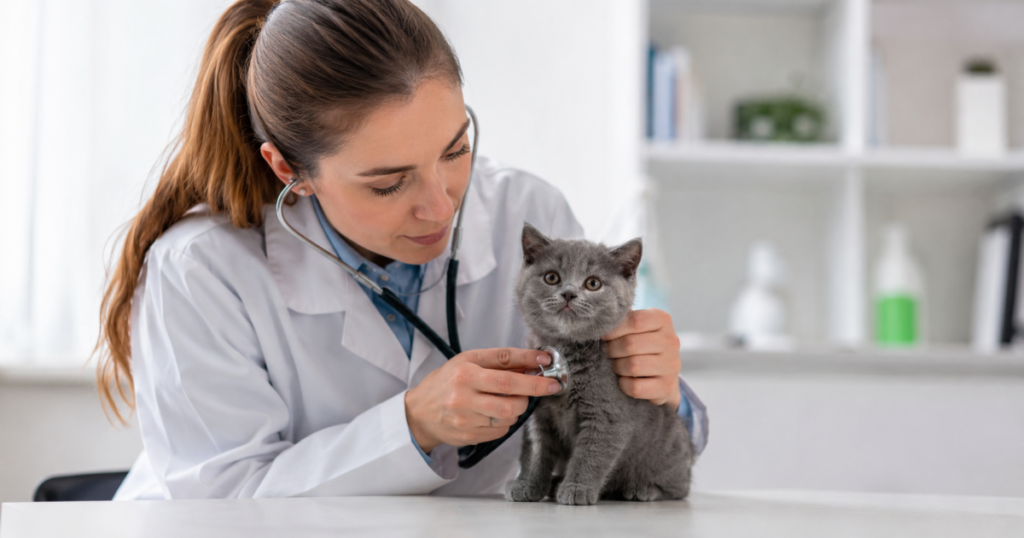
A routine spay surgery shouldn’t be a crisis. For a small number of British Shorthairs, it can be, and almost no one warns owners beforehand.
British Shorthair Pet Insurance: The Silent Genetic Risk
A British Shorthair kitten goes in for a routine spay or neuter, a procedure done safely on thousands of cats every week. This time, the bleeding won’t stop, and no one in the room saw it coming.
There’s no injury, no obvious cause, just a cat that looks entirely healthy right up until a scalpel meets skin. This is how Hemophilia B most often reveals itself in this breed, and it’s a documented, published risk that almost no British Shorthair pet insurance guide covers in any real depth.
British Shorthair pet insurance conversations tend to circle the same two conditions, HCM and PKD. Both are real. Neither is the whole story.
Buried in veterinary literature since 1993 is a third, rarer risk specific to this breed, one that behaves nothing like the others and catches owners completely off guard because it hides until the exact moment a cat needs surgery.
What Hemophilia B actually is
Hemophilia B is a hereditary deficiency of Factor IX, one of the proteins blood needs to clot properly and stop bleeding normally. Without enough of it, a cat’s blood simply doesn’t seal wounds the way it should.
The Merck Veterinary Manual describes the standard treatment for British Shorthair hemophilia as repeated transfusions of fresh frozen plasma, given every 12 hours until bleeding resolves. There is no cure, only management of individual bleeding episodes as they happen.
The condition was first documented specifically in British Shorthairs in a 1993 case report published in the Journal of the American Veterinary Medical Association, describing a family of affected cats and the pedigree that carried it forward across multiple generations before it was formally recognized.
Why some British Shorthairs carry it invisibly
This is exactly why the condition is so easy to miss for generations. A breeding line can carry the mutation silently through multiple healthy-looking females before it finally shows up in a male kitten, often at the worst possible moment, his first surgery, with no advance warning to anyone involved.
Recognizing the signs before surgery, not during it
UFAW’s veterinary summary lists the clinical picture clearly: episodes of lameness, swelling and bruising under the skin, weakness, appetite loss, fever, and general depression. Anemia can follow from blood loss, adding lethargy and irregular heartbeats to the picture. None of these signs are exclusive to Hemophilia B on their own, which is exactly why they’re so easy to dismiss individually.
The cruelest part is that mild cases show almost nothing day to day. A cat can seem completely normal until an injury, a dental cleaning under anesthesia, or a routine spay triggers uncontrolled bleeding that requires emergency intervention.
Vet Help Direct’s clinical summary notes that most diagnosed cases surface before age one, often at exactly the age spay and neuter procedures are typically scheduled, which is precisely why the timing feels so cruel in retrospect. A condition that could have been screened for calmly instead announces itself in an operating room.
Pre-surgery risk self-check
The other conditions British Shorthair pet insurance actually gets asked about
Hemophilia B is rare. These three are not, and they’re what most of your monthly premium is realistically protecting against over your cat’s lifetime.
Hypertrophic cardiomyopathy (HCM)
The most common heart disease in cats generally, and specifically flagged as a breed risk for British Shorthairs. Left untreated, HCM can progress to Feline Arterial Thromboembolism, a clotting emergency in its own right, unrelated to Hemophilia B but similarly sudden.
One documented emergency case involved roughly $4,800 in hospitalization and clot treatment, plus another $1,400 for the cardiac workup and initial medication that followed.
Polycystic kidney disease (PKD)
An inherited condition causing fluid-filled cysts in the kidneys from birth, worsening over time as the cysts grow and gradually compromise kidney function. Documented treatment costs can reach roughly $6,000 as the disease progresses, and management is lifelong once diagnosed, with no path to reversal.
Obesity and its downstream costs
British Shorthairs are widely noted for a tendency toward rapid weight gain, a trait tied to their calm, low-activity temperament as much as anything genetic. Obesity itself typically isn’t a covered condition, but what it causes often is.
One documented case of obesity-related diabetes ran $421 in initial equipment and diagnosis, followed by $162 a month in ongoing insulin, over $2,000 a year in a condition largely driven by weight.
What a pre-surgical clotting screen actually involves
If a British Shorthair owner does want to check proactively, the process itself is straightforward. A vet draws a blood sample and runs standard coagulation screening tests, commonly the activated partial thromboplastin time and prothrombin time, both of which are widely available at general veterinary clinics rather than requiring a specialist referral.
Carrier females and mildly affected cats can sometimes show normal results on these basic screening tests, since Cornell’s veterinary coagulation resources note that carrier animals with 40 to 60% of normal factor IX activity are often subclinically affected, meaning routine screening alone won’t always catch every case.
A more definitive answer requires a specific factor IX activity assay, which is less commonly run as a default test and typically needs to be requested directly.
For a British Shorthair with any personal or family history of unexplained bruising or bleeding, asking a vet specifically for this test before an elective surgery is a reasonable, low-cost precaution rather than an overreaction.
What British Shorthair insurance cost actually looks like
Figures cluster more tightly here than for many breeds. One 2026 breed analysis puts British Shorthairs at $45 to $85 a month for a 6-year-old cat, ranking them the 10th most expensive cat breed to insure. PetCareHelperAI’s independent estimate lands lower, at $35 to $55 a month.
Multiple other sources cluster around $27 to $40 a month for younger adult cats, climbing toward $60 to $95 for seniors. If you’re specifically searching for pet insurance for British Shorthair cats at the kitten stage, expect the lowest end of that range, since age is the single biggest driver of premium cost for this breed.
As a planning figure, budgeting $30 to $70 a month covers most realistic scenarios for an adult British Shorthair, with British Shorthair health insurance costs rising steadily rather than jumping sharply at any one age milestone.
| Provider | British Shorthair-relevant notes |
|---|---|
| AKC Pet Insurance | Ranked a top provider for the breed by independent comparison data; may reconsider certain incurable pre-existing conditions after 365 days |
| Pets Best | Frequently cited as offering the lowest starting premiums for this breed among major providers |
| Trupanion | Per-condition deductible model; relevant if a cat has both a hereditary condition and an unrelated illness, since each gets its own deductible |
| MetLife | Standard accident-and-illness coverage for hereditary conditions once enrolled and past the waiting period, provided no prior symptoms are documented |
Always confirm current terms directly with the provider, since exclusion language for hereditary and congenital conditions is updated periodically and varies meaningfully by state.
The one question worth asking before you buy
Ask directly whether the policy excludes hereditary conditions by default. HCM, PKD, and Hemophilia B are all hereditary. A policy that automatically excludes hereditary conditions provides very little real protection for this specific breed, regardless of how attractive the premium looks on paper.
Frequently asked questions
No, it’s genuinely rare, first documented in the breed in a single 1993 case report. Its rarity is exactly why it’s poorly covered elsewhere, not because it’s unimportant, but because it affects too few cats for most content to bother researching it in depth.
Under a standard accident-and-illness policy, yes, as long as no symptoms were documented before enrollment and the waiting period has passed. Because it’s hereditary, confirm your specific policy doesn’t carry a blanket hereditary-condition exclusion, since that would override standard coverage regardless of timing.
Yes. Because the condition is X-linked, a female cat can carry a single copy of the mutation and show no clinical signs at all, while still passing it to roughly half her male kittens on average. This is part of why the condition can persist unnoticed through a breeding line for generations.
Estimates generally fall between $27 and $85 a month depending on the source, your cat’s age, and location, with $30 to $70 a month covering most realistic scenarios for an adult cat.
It’s a reasonable question, particularly for male kittens, though clotting-specific screening is far less standardized than HCM or PKD testing in this breed. Asking directly about any known bleeding history in the pedigree costs nothing and may surface useful information.
Hypertrophic cardiomyopathy and polycystic kidney disease are the two most clinically significant, well-documented risks, followed by a genuine breed tendency toward obesity and its downstream effects like diabetes and joint stress.
The bottom line
British Shorthairs are calm, robust cats by reputation, and that reputation is largely earned. Hemophilia B affects a genuine minority of the breed, but its danger isn’t its frequency, it’s its invisibility. A cat can carry it, or carry the gene silently as a female, right up until a routine procedure turns into an emergency.
Between that specific risk and the more common HCM and PKD concerns, British Shorthair pet insurance purchased early, in the roughly $30 to $70 a month range, with confirmed hereditary condition coverage, is what actually protects against the full picture, not just the two conditions everyone already talks about.
For related breed risk profiles, see our guides on Maine Coon pet insurance and Ragdoll pet insurance, two other breeds with documented HCM risk. You can also learn more about how we research every guide on our About page.
Sources
- UFAW, British Shorthair, Haemophilia B
- Maggio-Price L, Dodds WJ, Factor IX Deficiency (Hemophilia B) in a Family of British Shorthair Cats, JAVMA (1993, peer-reviewed)
- Merck Veterinary Manual, Coagulation Protein Disorders in Animals
- eClinpath, Cornell University, Inherited Coagulation Deficiencies
- Vet Help Direct, What Cats Get Haemophilia?
Sarah researches and writes PetCoverToday's guides, checking every cost figure, coverage term, and policy rule directly against insurers' own published pages and, where relevant, veterinary and industry sources. PetCoverToday is an independent research resource, not a licensed insurance agency, and does not sell policies directly. Read more about how we research and fact-check every guide.