
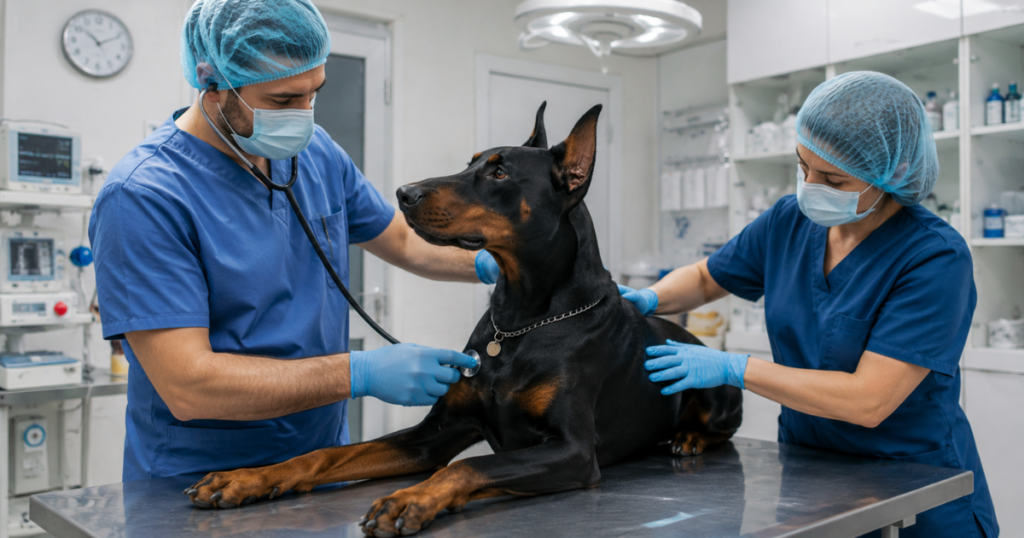
More than two-thirds of Dobermans carry a bleeding disorder that usually stays completely invisible right up until the exact moment a scalpel touches skin.
Doberman Pet Insurance: The Bleeding Disorder Behind Surgery Day Claims
A Doberman puppy goes in for a routine neuter. Nothing unusual, no red flags, no reason to expect anything but a standard, uneventful procedure.
Then the bleeding won’t stop. What started as a completely elective surgery, the kind pet insurance generally doesn’t cover at all, has become an emergency. This is exactly how von Willebrand Disease most often reveals itself in this breed, and what happens next, whether that complication itself is covered, is the part most breed guides skip entirely.
Doberman pet insurance conversations tend to focus on the breed’s cardiac risk, and for good reason, Dobermans carry one of the highest documented rates of dilated cardiomyopathy of any breed.
What gets far less attention is a second, widespread condition, a bleeding disorder carried by most of the breed, that creates a real, specific insurance timing problem rarely covered in this level of detail.
Understanding von Willebrand Disease
Von willebrand disease dog insurance questions almost always start the same way owners first learn about the condition itself, after an unexpected bleeding event. Von Willebrand Disease, vWD, is the most common inherited bleeding disorder in dogs.
It’s caused by a deficiency or dysfunction of von Willebrand factor, a protein that acts like glue, helping platelets stick together and seal off injured blood vessels.
Dogs with vWD have normal platelets, they simply can’t hold them in place at an injury site the way an unaffected dog can. The result is prolonged, sometimes severe bleeding after even routine trauma or minor procedures.
In more serious cases, this shows up as spontaneous bleeding from the nose, gums, or elsewhere with no injury at all.
Not every breed carries the same severity
Recognizing the Warning Signs Beyond Surgery Day
Surgical complications are the most common way vWD reveals itself, but they’re not the only way. Owners who know what to watch for can sometimes catch this before any procedure is even scheduled.
Nosebleeds with no obvious cause, bleeding gums that seem disproportionate to teething or minor dental issues, unexplained bruising, or blood appearing in urine or stool are all worth mentioning to a vet, particularly in a breed with a documented carrier rate this high.
None of these signs confirm vWD on their own, since other conditions can cause similar symptoms, but they’re a reasonable prompt to ask about screening rather than waiting for a surgical emergency to force the question.
Female Dobermans carry an additional consideration: heavy bleeding during a heat cycle can also be a sign, and whelping complications in affected females can become serious without advance knowledge of their vWD status.
Why Spay and Neuter Timing Creates an Insurance Problem
This is where the real complexity lives, and it’s specific to how the pet insurance industry treats elective procedures.
Standard policies, across essentially every major provider, exclude spay and neuter surgery from coverage entirely, since it’s classified as a planned, preventive procedure rather than treatment for an accident or illness.
There’s a well-established exception to that rule: if a spay becomes medically necessary, the industry’s own example is an emergency spay for pyometra, a life-threatening uterine infection. Insurers will typically cover it, because at that point it’s treating an illness, not performing elective sterilization.
What happens when a routine procedure turns into an emergency
Why this is worth asking about before, not after
Because most Dobermans with vWD show zero symptoms until a bleeding event happens, and because that event most commonly happens during exactly the kind of routine surgery insurance doesn’t automatically cover, this breed faces an unusual timing trap.
A screening test taken before the spay or neuter, not after a crisis, is the only way to control the outcome directly.
What Screening for vWD Involves
The process itself is straightforward and inexpensive relative to the risk it addresses. A veterinarian can perform a buccal mucosal bleeding time test, a simple in-clinic procedure that times how quickly a small cut on the gum stops bleeding, as an initial screening step.
If that result raises suspicion, a specific blood test measuring von Willebrand factor concentration confirms the diagnosis. A DNA test is also available and can identify carrier status even in dogs that have never shown any symptoms, which matters given how many Dobermans are asymptomatic carriers.
Doberman Insurance Cost: A Realistic Range
Doberman health insurance runs in a moderate range compared to giant breeds with more severe documented risks, reflecting the breed’s mixed profile: a mild, usually manageable bleeding disorder alongside a serious cardiac risk. Estimates generally cluster between $35 and $90 a month for an adult dog.
Puppies enrolled before any vWD screening or bleeding history is documented sit at the lower end of that range, and represent the best opportunity to lock in coverage before the breed’s two major hereditary risks have any chance to affect eligibility.
Treatment and Complication Costs
| Item | Typical cost |
|---|---|
| Buccal mucosal bleeding time screening | $50 to $150 |
| Confirmatory von Willebrand factor blood test | $100 to $250 |
| DNA carrier test | $40 to $75 |
| Emergency bleeding complication, mild | $500 to $1,500 |
| Emergency bleeding complication requiring transfusion | $1,500 to $4,000+ |
| DDAVP treatment (used to temporarily raise vWF levels) | Variable, often used alongside emergency care rather than as a standalone cost |
The screening tests are inexpensive compared to the cost of an unmanaged bleeding emergency, which is why veterinary sources consistently recommend testing before any surgical procedure in a known at-risk breed, not just major ones, and not just once the dog is already scheduled for surgery.
Other Breeds With Documented vWD Risk
Pet insurance for dobermans guides tend to treat this as breed-specific, but vWD has been documented in more than 40 to 50 breeds.
Golden Retrievers, Shetland Sheepdogs, Rottweilers, Miniature Schnauzers, German Shepherds, German Shorthaired Pointers, Standard Poodles, Scottish Terriers, and Pembroke Welsh Corgis are all routinely recommended for screening. If you own one of these breeds, the same spay/neuter timing logic applies just as directly.
A Pre-Surgery Checklist for Doberman Owners
Before assuming doberman pet insurance won’t help with a bleeding complication, work through these steps.
- Ask for a bleeding time screen before your Doberman’s spay or neuter, not after a complication happens. This is a simple, low-cost, in-clinic test most vets can perform quickly.
- Ask your insurer directly how they’d classify a bleeding complication during an elective procedure, before you need the answer in an emergency. Policy language on this specific scenario is inconsistent across providers.
- Enroll your Doberman before any vet visit even mentions vWD or a bleeding episode. Once documented, it becomes pre-existing, and future bleeding-related claims tied to the same underlying condition become far harder to get reimbursed.
- Keep the screening result on file and share it with every vet who treats your dog, including for unrelated future procedures, since the risk doesn’t go away after one clear surgery.
Frequently Asked Questions
Yes, as a hereditary illness, under a standard accident-and-illness policy, provided it wasn’t diagnosed or symptomatic before enrollment and the waiting period has passed. The complicated part isn’t the diagnosis itself, it’s how a bleeding complication tied to an otherwise-uncovered elective procedure gets classified by a specific insurer’s claims team.
This isn’t consistent across the industry, and it’s worth asking your specific provider directly before surgery. The elective procedure itself won’t be covered, but a sudden, unexpected medical complication during it may be treated differently, similar to how an emergency spay for pyometra gets covered even though a routine spay doesn’t.
A screening study of over 15,000 Dobermans found more than 70% were carriers, though most were not showing symptoms at the time of testing. Dobermans typically carry the mildest form of the disease, Type 1.
Given how common asymptomatic carrier status is in this breed, testing before any planned surgery, not just after a problem appears, is what veterinary sources consistently recommend. A dog can be a carrier for years with zero visible signs before a surgical bleeding event reveals it.
Dilated cardiomyopathy is the breed’s other major, well-documented risk, and one of the more severe cardiac conditions across all dog breeds. See our Great Dane pet insurance guide for a deeper look at how DCM affects insurance decisions in cardiac-risk breeds generally.
Estimates generally fall in a broad $35 to $90 a month range for an adult dog, depending on age, location, deductible, and coverage limit, consistent with what mid-to-large breeds with documented hereditary risk typically cost to insure.
The Bottom Line on Doberman Pet Insurance
Doberman pet insurance decisions usually focus on heart screening and skip this entirely: Von Willebrand Disease affects most of this breed, usually invisibly, until the moment a routine, everyday procedure turns into a bleeding emergency.
That timing collision, an elective surgery insurance doesn’t cover, colliding with a complication that arguably should be, is a real gap in how this breed’s risk gets explained.
A simple, inexpensive screening test before any surgery, and a direct conversation with your insurer about how they’d handle a bleeding complication, are the two things that change the outcome here, not general breed research alone.
For related breed risk profiles, see our guides on Great Dane pet insurance, which covers a different cardiac and screening dilemma, and British Shorthair pet insurance, which covers a different breed-specific bleeding disorder in cats. You can also learn more about how we research every guide on our About page.
Sources
- VCA Animal Hospitals, Von Willebrand’s Disease in Dogs
- Cornell University Riney Canine Health Center, Von Willebrand Disease
- Veterinary Partner (VIN), Von Willebrand’s Disease in Dogs
- Today’s Veterinary Nurse, A Veterinary Nurse’s Guide to von Willebrand Disease
- ASPCA Pet Health Insurance, Does Pet Insurance Cover Spaying or Neutering?
Sarah researches and writes PetCoverToday's guides, checking every cost figure, coverage term, and policy rule directly against insurers' own published pages and, where relevant, veterinary and industry sources. PetCoverToday is an independent research resource, not a licensed insurance agency, and does not sell policies directly. Read more about how we research and fact-check every guide.