
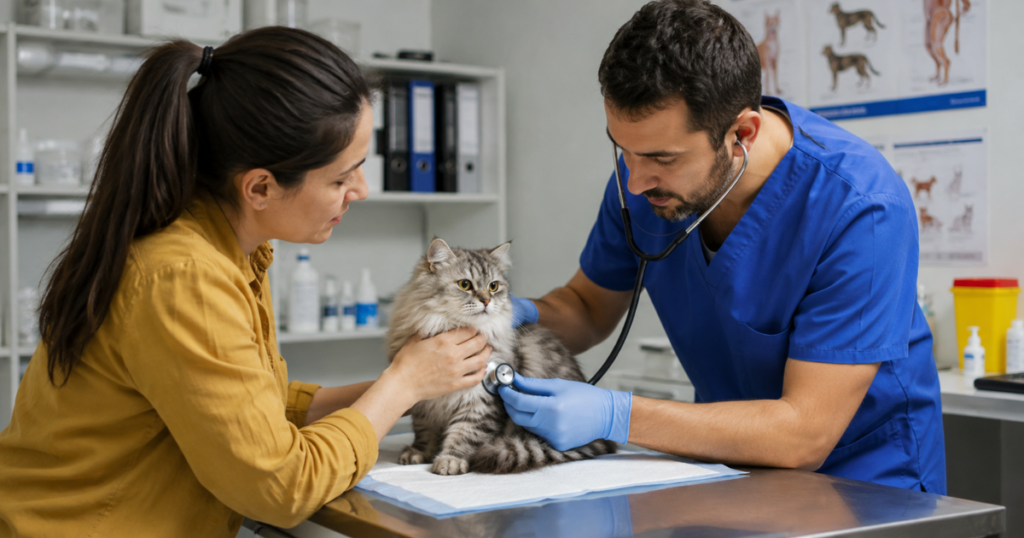
A disease that used to mean a near-certain goodbye now has a real cure. Almost nobody explains what that cure’s complicated legal history means for your insurance claim.
FIP Pet Insurance: The Cure Nobody Prepared You For
Your cat is diagnosed with FIP. A decade ago, this was close to a death sentence, a diagnosis most owners associated with weeks, not years, of remaining time.
Today, a real treatment exists, with cure rates veterinary researchers once thought impossible for this specific disease.
You start treatment, relieved. Then you file your insurance claim, and the paperwork gets complicated in a way nothing prepared you for.
FIP pet insurance conversations tend to stop at “yes, treatment exists now.” That’s true, and genuinely remarkable. What gets skipped is the part that actually determines whether your claim gets paid.
The drug that cures FIP has a complicated regulatory history, and most owners administer it at home with only limited veterinary involvement, a combination that runs headfirst into how insurers actually process medication claims.
From death sentence to treatable, in about a decade
Feline Infectious Peritonitis is caused by a mutation of a common feline coronavirus that many cats carry harmlessly. Historically, once symptomatic, it was considered close to universally fatal.
That changed with research into an antiviral compound called GS-441524, pioneered in large part by Dr. Niels Pedersen at UC Davis, building on decades of prior coronavirus research. Veterinarians in the UK and Australia began prescribing it years earlier than it became broadly available in the United States.
A related compound, molnupiravir, has since emerged as a comparably effective alternative, including as a rescue therapy when GS-441524 doesn’t fully resolve the disease.
Why the sourcing method changes everything for a claim
What feline infectious peritonitis insurance actually needs to cover
Pet insurance for cats with FIP genuinely differs from most other feline conditions in one key way: the disease itself moves fast. FIP can progress from vague symptoms, lethargy, appetite loss, a swollen abdomen, to critical within days, which means the diagnostic workup and treatment decision often happen under real time pressure.
Fip treatment cost insurance considerations should account for this urgency specifically. A policy with a low annual limit or a long illness waiting period leaves an owner facing thousands of dollars in treatment costs precisely when a fast decision matters most.
The insurance catch-22 almost nobody explains
Standard pet insurance policy language, confirmed across major providers’ own coverage explanations, reimburses medication only when it is prescribed by a licensed veterinarian to treat a covered illness. That’s a reasonable rule in the abstract.
It becomes a genuine problem for FIP specifically, because so much of the real-world treatment history for this exact disease happened outside that framework, self-sourced, self-administered, with veterinarians often monitoring from the sidelines rather than actively prescribing.
What actually improves your odds of reimbursement
Involve a veterinarian formally in diagnosis, treatment planning, and monitoring, even if the medication itself is compounded or sourced through a specialty channel. A documented diagnosis, a written treatment plan, and itemized veterinary records give a claim something concrete to point to, compared to a home treatment log with no formal prescription or veterinary oversight behind it at all.
Why FIP diagnosis itself remains genuinely difficult
Even with a real treatment available, confirming FIP isn’t always straightforward. There’s no single definitive blood test that confirms the disease in every case, and veterinarians often rely on a combination of bloodwork patterns, fluid analysis when effusion is present, imaging, and clinical presentation to reach a working diagnosis before starting treatment.
This diagnostic complexity matters for insurance too, since a documented, thorough workup, exactly the kind of records-heavy process that comes from real veterinary involvement, does double duty. It gives your cat the best chance at an accurate diagnosis and treatment plan, and it gives any future insurance claim something substantial to point to.
What fip treatment cost insurance actually looks like in practice
| Item | Typical cost |
|---|---|
| Diagnostic workup (bloodwork, imaging, fluid analysis) | $300 to $1,500 |
| Full GS-441524 or molnupiravir course (84 days, per published surveys) | $3,100 to $4,920 on average |
| Rescue therapy if first-line treatment fails | Additional $1,500 to $3,000+ |
| Follow-up bloodwork during and after treatment | $100 to $300 per visit |
One published cohort noted the average total cost had actually decreased since 2021 as sourcing shifted from injectable to oral pill formulations, though pricing still varies significantly by supplier, treatment duration, and individual cat weight, since dosing is calculated per kilogram over the full 84-day course.
How providers are slowly adapting to this new reality
Insurers built their standard reimbursement language around a world where FIP had no real treatment to cover, so the fine print on this specific scenario is genuinely still catching up to the medicine.
A handful of providers have begun explicitly referencing antiviral FIP treatment in their own marketing and educational content, a signal that awareness is growing even if formal policy language hasn’t fully adapted yet.
This is worth watching if you’re comparing providers specifically for a cat with elevated FIP risk. A provider that acknowledges the treatment exists in its own materials is at least a starting point for a more informed conversation about what documentation they’ll actually require.
Recognizing FIP early matters more now than it ever did
When FIP had no real treatment, early detection mattered mainly for making end-of-life decisions with as much information as possible. Now, catching it early genuinely changes outcomes, since treatment tends to work better before the disease has progressed to severe neurological or ocular involvement.
The classic warning signs include persistent fever that doesn’t respond to antibiotics, progressive lethargy, appetite loss, and in the effusive form, a visibly swollen or fluid-filled abdomen that can develop gradually or seem to appear almost overnight.
Kittens and young cats, along with purebred cats generally, carry documented elevated risk, making unexplained persistent fever in a young cat specifically worth investigating rather than dismissing.
None of these signs are exclusive to FIP, and a proper diagnosis requires veterinary testing, not guesswork alone based on symptoms at home.
But bringing a cat in promptly when these signs appear, rather than waiting to see if things improve on their own, is now a genuinely different decision than it used to be, given what treatment can actually accomplish today.
What to actually do for fip pet insurance if your cat is diagnosed
- Get your veterinarian formally involved from diagnosis onward, not just for the initial workup. Ongoing documented involvement matters more for a claim than a single diagnostic visit, since it shows a continuous, professionally-supervised course of treatment rather than a one-time consultation followed by self-managed care at home.
- Ask your insurer directly how they handle GS-441524 or molnupiravir specifically, before assuming standard prescription-drug rules apply cleanly to this situation.
- Keep every record: diagnosis notes, a written treatment plan, weight-based dosing calculations, and receipts, even for compounded or specialty-sourced medication.
- Enroll before any symptoms appear, if you’re insuring a cat from a background with elevated FIP risk. Purebred cats face documented higher odds of FIP than mixed-breed cats, and coverage timing follows the same pre-existing condition rules as every other illness.
Frequently asked questions
Yes, in principle, under a standard accident-and-illness policy, as long as it isn’t pre-existing and the waiting period has passed. The complication isn’t whether feline infectious peritonitis insurance covers the diagnosis itself, it’s whether the specific way the medication was obtained and administered meets the policy’s requirements for reimbursement.
Its regulatory status has evolved and varies by country, with the UK and Australia approving it earlier than the US. Owners should confirm current legal status and sourcing options with a licensed veterinarian rather than relying on outdated information, since this is an area that continues to change.
What was accurate a year ago may not reflect the current regulatory picture, which is part of why direct confirmation matters here more than usual.
It depends heavily on the provider and documentation. A vet-prescribed and vet-monitored compounded medication has a meaningfully better chance of reimbursement than the same drug sourced and administered entirely outside veterinary involvement.
Published cohort studies report cure or sustained remission rates ranging from roughly 54% to 96.7%, depending on the study population, treatment protocol, and how “cured” is defined. This is a dramatic shift from a disease once considered close to universally fatal.
Yes. Purebred cats show documented higher odds of developing FIP compared to mixed-breed cats, which makes enrollment timing especially relevant for owners of purebred kittens before any symptoms are ever documented.
Before, without question. Since purebred cats carry documented elevated FIP risk, and any symptom or diagnosis before enrollment becomes permanently excluded as pre-existing, enrolling as early as possible, ideally before any vet visit even mentions the disease, gives you the best chance of actual coverage if it’s ever needed.
The bottom line on fip pet insurance
FIP going from a near-certain death sentence to a genuinely treatable disease is one of the more remarkable developments in recent veterinary medicine. The insurance side of that story hasn’t caught up as cleanly.
Because so much of this treatment’s real-world history happened through channels outside standard veterinary prescribing, getting reimbursed depends heavily on documentation, formal vet involvement, and asking your specific provider the right questions before you’re in the middle of a crisis, not after.
Fip pet insurance, done right, starts with enrollment timing and continues with careful documentation every step of the way if diagnosis ever happens, from the very first symptomatic vet visit through the final follow-up bloodwork confirming remission.
For more on how cat breed risk factors compare, see our Ragdoll pet insurance guide, which covers FIP risk specifically for that breed, or explore our Breed Health Risk Finder for a broader comparison across the cat and dog breeds we’ve researched in depth. You can also learn more about how we research every guide on our About page.
Sources
- Owner experience and veterinary involvement with unlicensed GS-441524 treatment of FIP: a prospective cohort study, peer-reviewed
- Unlicensed GS-441524-Like Antiviral Therapy for At-Home Treatment of FIP, peer-reviewed
- Unlicensed Molnupiravir as Rescue Treatment Following GS-441524 Failure, peer-reviewed
- GS-441524 and Molnupiravir: Comparable Effectiveness for FIP Treatment, peer-reviewed
- Animal Medical Center, Finally, a Treatment for FIP: How GS-441524 is Saving Cats’ Lives
Sarah researches and writes PetCoverToday's guides, checking every cost figure, coverage term, and policy rule directly against insurers' own published pages and, where relevant, veterinary and industry sources. PetCoverToday is an independent research resource, not a licensed insurance agency, and does not sell policies directly. Read more about how we research and fact-check every guide.