
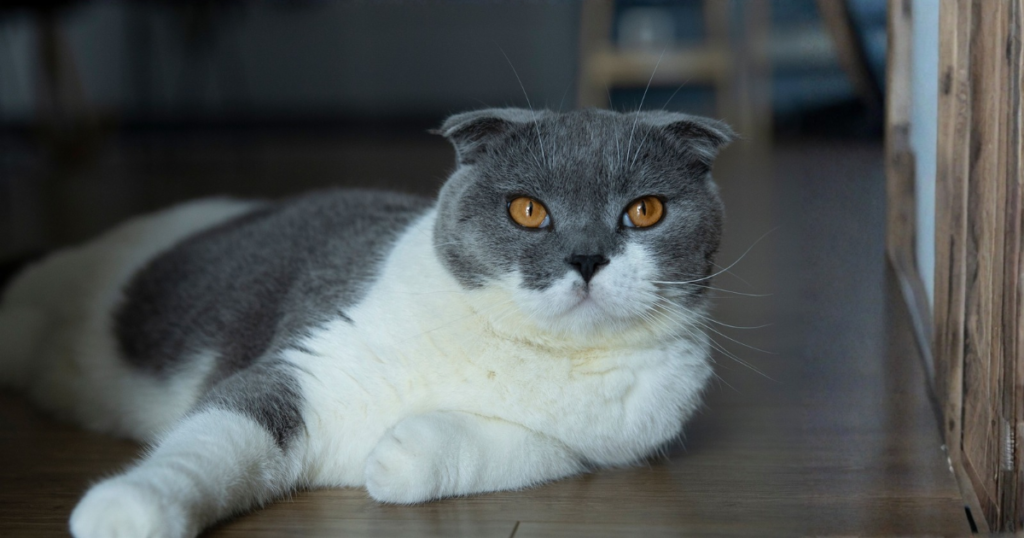
The same gene that folds a Scottish Fold’s ears is believed by veterinary welfare organizations to affect cartilage throughout its entire body. Here is what the science, the controversy, and the real costs actually look like.
Scottish Fold Pet Insurance: What the Ear Mutation Actually Means
Every Scottish Fold’s signature look, the forward-folded ears that made this breed famous, comes from a single genetic mutation. According to the UK based welfare charity UFAW and the veterinary organization International Cat Care, that same mutation is believed to affect cartilage development throughout the entire skeleton, not just the ears.
This is not a typical breed risk story. Most conditions we cover are things a breed is merely prone to. Scottish Fold pet insurance is different because the trait that defines the breed and the disease that concerns veterinarians are, biologically, the same thing.
The genetics behind the ears
The fold in a Scottish Fold’s ears comes from an autosomal dominant gene, commonly labeled Fd, that affects how cartilage forms. Because it’s dominant, a kitten needs only one copy to have folded ears. That same gene disrupts cartilage development elsewhere in the body too, particularly in the joints and tail, a condition called osteochondrodysplasia, often shortened to SFOCD.
Cats with two copies of the gene tend to develop more severe, earlier onset disease. Cats with a single copy, still enough to produce the folded ear look, can also develop the condition, sometimes with milder symptoms that progress more slowly.
This is why breeders have historically paired Scottish Folds with straight eared cats, to avoid producing kittens with two copies, though even a single copy carries real risk. Reputable breeders who take this seriously will often disclose the genetic status of a kitten’s parents on request, which is worth asking about directly.
A genuine disagreement worth showing honestly
This is where the research gets complicated, and worth presenting exactly as it is rather than picking a side. Veterinary welfare organizations state the risk in absolute terms. UFAW’s published guidance says osteochondrodysplasia is seen in every Scottish Fold cat carrying a copy of the Fd gene. International Cat Care uses similarly direct language.
Real world clinical data tells a narrower story. A 2023 retrospective study using VetCompass records from Australian veterinary clinics found a clinical diagnosis rate of just 1.1%, 12 out of 1,131 Scottish Fold cats, with an additional group flagged as suspected but unconfirmed cases.
What welfare organizations say
UFAW and International Cat Care state the underlying cartilage abnormality is present in every cat carrying the fold gene, to some degree.
What clinical records show
A large Australian VetCompass study found formal diagnosis rates far lower, likely because many mild cases go unrecognized or untreated.
The likely explanation for the gap isn’t that the two sources disagree on the biology, it’s that a formal clinical diagnosis requires radiographic imaging and a vet visit specifically for symptoms severe enough to prompt one.
Many cats with mild cartilage changes may simply never be brought in and diagnosed, even if the underlying abnormality is technically present. Both things can be true at once: the mutation’s effects may be nearly universal at the cellular level, while clinically significant, diagnosed disease remains uncommon.
This is exactly the kind of nuance that matters for Scottish Fold pet insurance decisions, since a mild, undiagnosed case today can still become a documented, excluded condition later.
Why some registries won’t recognize the breed
This tension has real regulatory consequences. The International Cat Association recognizes Scottish Folds as an official breed. The Fédération Internationale Féline and the UK’s Governing Council of the Cat Fancy do not, specifically citing welfare concerns tied to the fold mutation.
International Cat Care has gone further, stating plainly that continuing to breed cats with a mutation known to cause painful disease is not ethical. Few breeds have this level of open, documented disagreement among major cat registries about whether the breed should exist in its current form at all.
None of this is intended to tell you whether to own one, that decision belongs to you. But it’s exactly the kind of context that matters when deciding how seriously to take insurance timing and coverage depth for this specific breed.
What actually happens to a policy given a congenital condition
The core insurance problem
Because the fold mutation is present from birth, not something that develops later like many hereditary conditions in other breeds, the usual advice to enroll before symptoms appear takes on extra weight here.
If any skeletal symptom, even mild stiffness noted at a routine visit, is documented before your Scottish Fold pet insurance policy’s waiting period ends, insurers can treat SFOCD as pre-existing and exclude it permanently. Given symptoms can appear as early as 7 weeks old, the window to enroll before any documentation exists is genuinely short.
Once excluded as pre-existing, no future policy, with any provider, will cover treatment for it. What remains covered is everything else: infections, unrelated injuries, dental disease, and any new condition unrelated to the skeletal mutation.
What Scottish Fold health care actually costs
| Item | Typical cost |
|---|---|
| Diagnostic radiographs (per session) | $150 to $400 |
| Ongoing pain management (NSAIDs, monthly) | $20 to $60 |
| Glucosamine and joint supplements (monthly) | $15 to $40 |
| Advanced imaging (CT, if needed) | $800 to $2,000 |
| Lifetime SFOCD management, full range | $2,000 to $15,000 |
There is no surgical cure for SFOCD. Treatment is management, medication, supplements, and pain control aimed at quality of life rather than resolution, which is part of why the lifetime cost estimate spans such a wide range depending on severity.
Premiums by life stage
| Life stage | Monthly premium range |
|---|---|
| Kitten (under 1 year) | $22 to $38 |
| Young adult (1 to 4 years) | $28 to $50 |
| Middle-aged (5 to 8 years) | $40 to $68 |
| Senior (9+ years) | $62 to $98 |
A $250 annual deductible paired with 90% reimbursement is the configuration most commonly recommended for this breed specifically, balancing a manageable premium against a condition that generates recurring, ongoing costs rather than one large single event.
How to manage costs beyond the premium
A few practical steps genuinely help, regardless of what policy you choose.
Ask breeders directly about genetic status. A reputable, welfare conscious breeder should be willing to discuss whether a kitten’s parents carry one or two copies of the fold gene, and whether any straight eared cats were used in the pairing.
Keep your cat at a healthy weight. Excess weight adds mechanical stress to joints already affected by abnormal cartilage development, and weight management is one of the few genuinely controllable factors in how comfortably a cat with SFOCD lives.
Choose a policy with strong prescription drug coverage specifically. Since management is ongoing rather than a single procedure, the difference between a plan that covers monthly medication well and one that doesn’t compounds significantly over a cat’s lifetime.
Document everything from the very first vet visit. Keeping detailed records, even of visits that turn up nothing concerning, can help clarify the actual date any symptom was first noted if a coverage dispute ever arises later.
What to look for in a policy
- Confirm hereditary and congenital conditions are covered, not excluded by default, since SFOCD falls into both categories depending on how a provider classifies it.
- Ask directly how the insurer treats symptoms noted at a very early age. Given how young clinical signs can appear, this detail matters more here than for almost any other breed.
- Prioritize ongoing prescription and management coverage, not just emergency care, since SFOCD is typically managed with recurring medication rather than a single procedure.
- Enroll as close to birth as realistically possible. Every week of delay is a week during which a routine vet visit could document a symptom that becomes permanently excluded.
Is Scottish Fold pet insurance worth it?
Run the comparison plainly. At $35 a month, a reasonable mid-range figure, a year of coverage costs $420. Lifetime SFOCD management can run anywhere from $2,000 to $15,000 depending on severity, on top of routine care every cat needs regardless of breed.
Given how early symptoms can appear and how directly tied this risk is to the breed’s defining trait, Scottish Fold pet insurance secured before any vet visit ever documents stiffness or lameness is one of the more clearly justified early enrollment decisions in this entire category.
Frequently asked questions
Veterinary welfare organizations state that the underlying cartilage abnormality is present in every cat carrying the fold gene to some degree, though formally diagnosed clinical cases are far less common, around 1.1% in one large clinical records study. Severity varies significantly between individual cats.
Yes, generally, as long as no symptom was documented before your policy’s waiting period ended. Once any sign is noted in medical records, it can be treated as pre-existing and excluded from that policy and any future one.
Realistic 2026 ranges run from about $22 a month for a kitten to $98 a month for a senior cat, depending on age, location, deductible, and reimbursement level chosen.
No. There is no surgical or medical cure. Treatment focuses on pain management and quality of life through medication, joint supplements, and in some cases surgical intervention for severe cases, rather than resolving the underlying cartilage abnormality.
The Fédération Internationale Féline and the UK’s Governing Council of the Cat Fancy decline to recognize the breed specifically because of welfare concerns tied to the fold mutation’s effect on cartilage. The International Cat Association does recognize the breed.
As early as possible, ideally before the kitten’s first veterinary visit that could document any skeletal symptom. Since signs can appear by 7 weeks of age, the safe window for enrollment before any documentation exists is genuinely narrow.
The bottom line
Scottish Folds carry a genuinely unusual health story: the same mutation responsible for the breed’s most recognizable feature is also, according to veterinary welfare authorities, responsible for a lifelong skeletal condition. Real clinical diagnosis rates are lower than the theoretical risk suggests, and that gap is worth understanding rather than glossing over.
What doesn’t change is the insurance math: enrolling before any symptom is ever documented, given how early they can appear, is the only way to guarantee coverage for a condition this directly tied to the breed itself.
For more on how pre-existing condition timing works generally, see our Pre-Existing Conditions guide, and for another breed shaped by a single well documented genetic risk, read our Golden Retriever pet insurance guide. You can also learn more about how we research every guide on our About page.
Sources
- UFAW, Scottish Fold Osteochondrodysplasia
- International Cat Care, Scottish Fold Osteochondrodysplasia
- Prevalence of Osteochondrodysplasia in Australian Scottish Fold Cats, VetCompass/PMC
- PetMD, Osteochondrodysplasia in Cats
- Catster, Osteochondrodysplasia in Scottish Folds
- Wrisor, Cat Insurance vs Wellness Plan for a Scottish Fold
Sarah researches and writes PetCoverToday's guides, checking every cost figure, coverage term, and policy rule directly against insurers' own published pages and, where relevant, veterinary and industry sources. PetCoverToday is an independent research resource, not a licensed insurance agency, and does not sell policies directly. Read more about how we research and fact-check every guide.